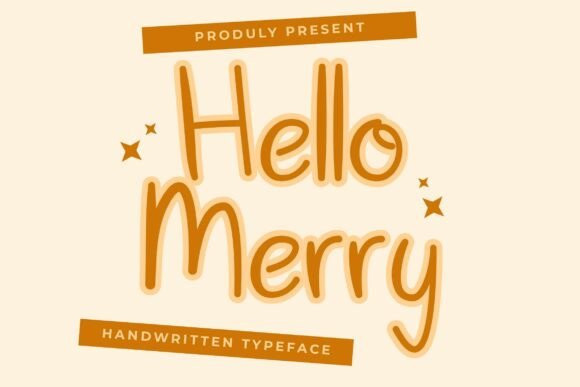
Hello Merry: A Handwritten Font That Feels Like a Warm Welcome
It was 8 a.m. on a rainy Tuesday, and I was elbow-deep in label mockups for my friend’s small-batch candle studio—hand-poured soy candles with names like “Hearth Light” and “Pine & Paper.” She’d just switched to kraft paper jars and wanted packaging that felt personal but polished—not too cutesy, not too corporate. Her old font? A generic script she’d grabbed free online. It looked stiff, uneven, and somehow… distant. Customers loved her scents, but the labels didn’t reflect the care she put into every wick trim and pour. That’s when we tried Hello Merry.
What Makes Hello Merry Feel So Human—and Why That Matters
Hello Merry is a premium handwritten font from Script Amp, designed not as a decorative flourish, but as a quiet, confident voice for small businesses. It’s not overly looped or exaggerated—it leans into natural rhythm: bouncy curves, soft entry and exit strokes, and subtle variations in line weight that mimic real pen-on-paper movement. There’s warmth in its tilt, sincerity in its spacing, and personality in its organic flow. Unlike many script fonts that sacrifice readability for flair, Hello Merry keeps clarity front and center—even at smaller sizes.
For a candle maker, that meant “Lavender Fog” legible on a 1.5-inch jar label. For the neighborhood café reworking their chalkboard-style menu, it meant “House Oat Latte” looking inviting—not intimidating—on both printed menus and Instagram Stories. This isn’t just about aesthetics; it’s about first impressions. When someone sees your product label, business card, or website banner, typography is often the first thing they register—before color, before imagery. Hello Merry says, “We made this with care,” without saying a word.
Where It Shines (and Where to Use It Thoughtfully)
As a display font and script font, Hello Merry excels in short-form, high-impact contexts:
- Product labels and packaging titles — Perfect for soap bars, tea tins, jam jars, or boutique gift tags where you want name recognition + emotional resonance.
- Logo design and brand accents — Works beautifully as a primary logo for lifestyle brands, wellness studios, or handmade goods—especially when paired with clean supporting type.
- Thank-you cards and stickers — Its handwritten charm feels sincere, never automated. Ideal for post-purchase touches that build loyalty.
- Social media graphics and shop banners — Stands out in thumbnails and mobile feeds without competing with photos or illustrations.
That said, Hello Merry isn’t built for body text or long paragraphs. It’s a headline-first typeface—best used for names, taglines, short quotes, or decorative accents. On tiny product stickers or narrow candle jar bands, keep phrases under four words. For web use, pair it with a highly legible sans serif (like Inter, Poppins, or Montserrat) for navigation, pricing, and descriptions. The contrast creates balance: warmth up top, clarity below.
Real Pairings That Just Work
Font pairing isn’t magic—it’s intention. With Hello Merry, simplicity wins. Try these combinations, all tested on real client projects:
- A warm sans serif — Think Poppins Regular or Nunito Sans. Clean, friendly, and widely supported across devices. Used for ingredient lists on skincare labels or size charts on an online shop.
- An elegant serif — Playfair Display or Cormorant Garamond adds quiet sophistication. Great for wedding stationery, boutique branding, or editorial-style product storytelling.
- A second script (sparingly) — Only if you need variation (e.g., a slightly tighter script for subheadings). But Hello Merry includes ligatures and stylistic alternates—so you often don’t need a second script at all.
The included OpenType features—like contextual alternates and swash capitals—are subtle but powerful. They prevent repetition in logos or repeated phrases (“Handmade • Small Batch • Local”) and add polish without extra work.
Practical Tips Before You Install
Before dropping Hello Merry into your next project, check three things:
- Licensing — Confirm it’s cleared for commercial use on physical products (labels, packaging, merchandise) and digital templates (Canva, Shopify banners, email headers). Script Amp fonts typically include full commercial rights—but always verify.
- File formats — Look for OTF and WOFF2 files. OTF gives you access to OpenType features in design apps; WOFF2 ensures crisp rendering on websites.
- Multilingual support — If you serve customers who use accented characters (é, ñ, ü), check whether the font covers Latin Extended-A. Most Script Amp fonts do—but double-check the specimen sheet.
I’ve used Hello Merry across print and digital: on matte-finish bakery boxes, woven fabric tags for a linen shop, animated Instagram highlights, and even embroidered patches. In every case, it added cohesion—not clutter. It helped unify disparate touchpoints (a sticker, a receipt, a story highlight) under one recognizable tone. That consistency builds trust. And trust? That’s what turns a one-time buyer into someone who saves your Instagram posts and tells friends where they found “that perfect candle.”
Typography isn’t decoration. It’s conversation. And Hello Merry speaks in a voice that’s joyful, grounded, and unmistakably human—exactly what so many small businesses need right now.